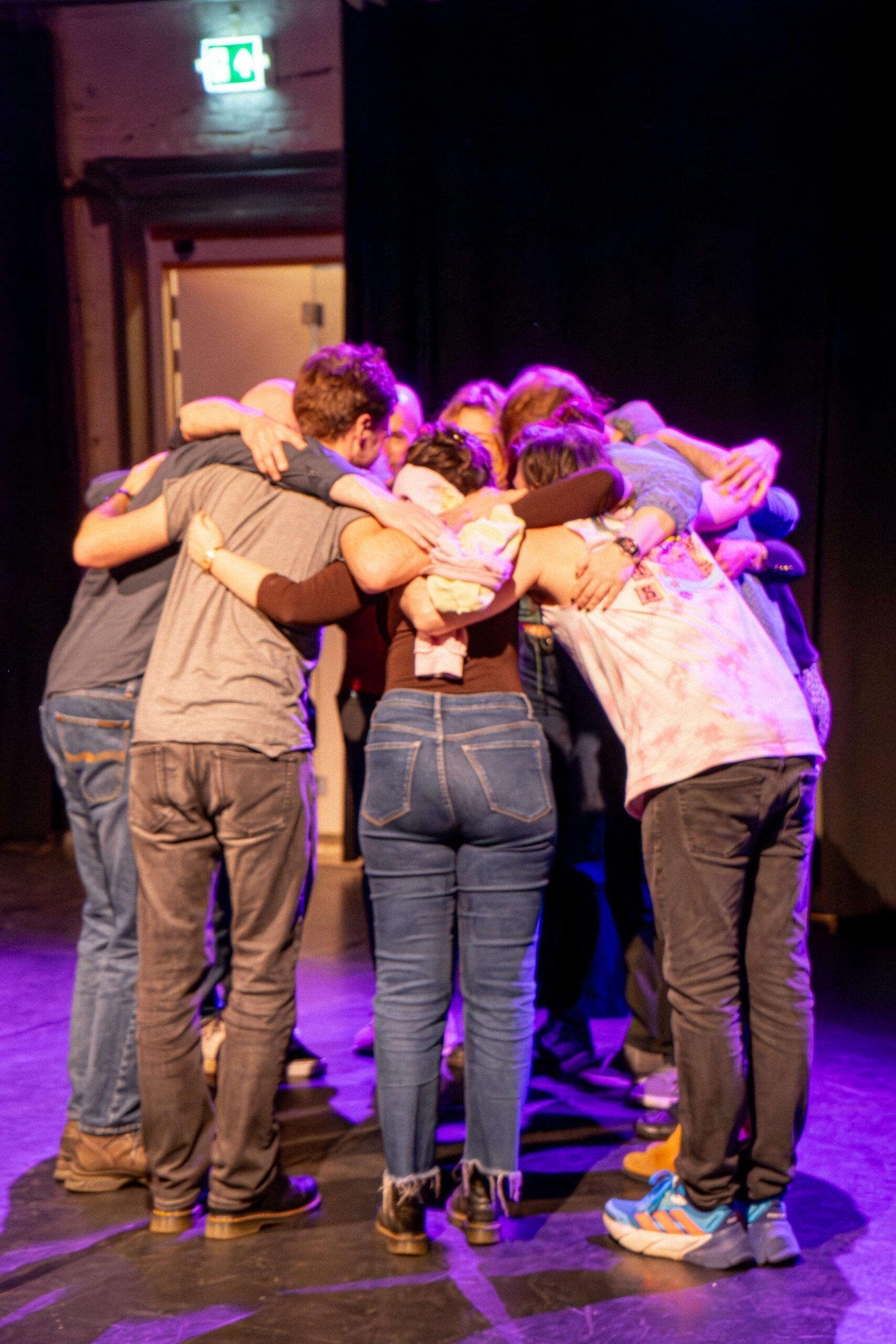
Steven Morgan offers bespoke improv coaching for groups who want to deepen their work, sharpen their craft, and create performances that audiences genuinely want to watch. Whether a group is preparing a long form show, developing a house team, refining an existing format, or drilling into specific skills, the coaching is always shaped around the needs, ambitions, and realities of the group in front of him.
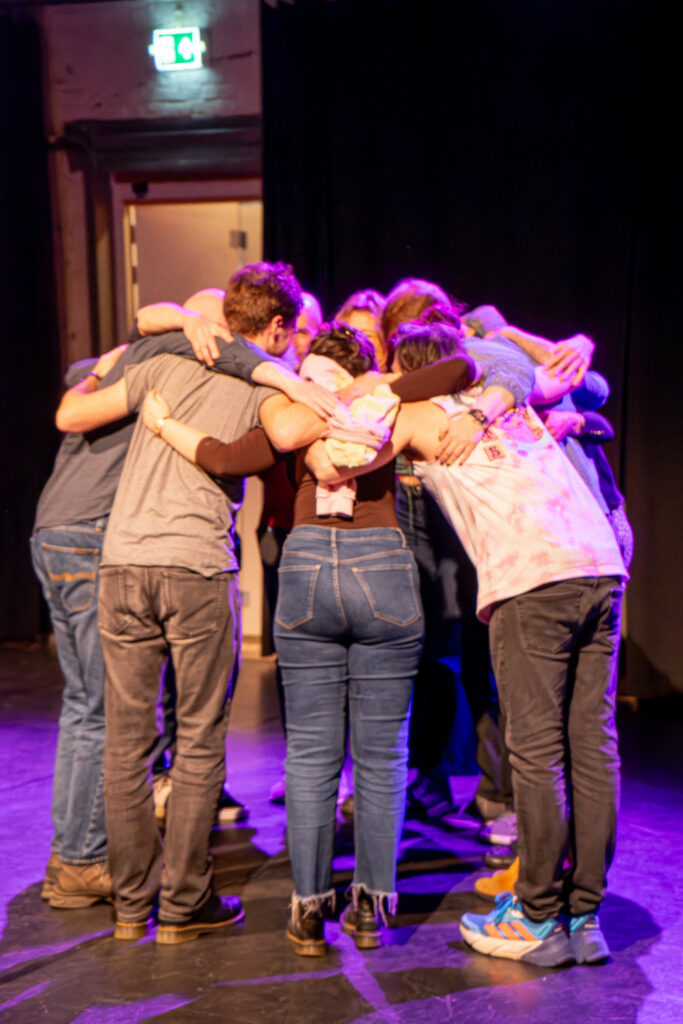
This is not a one-size-fits-all approach. Coaching begins with understanding what kind of experience the group wants to create, how they currently work together, and where they feel both confident and stuck. From there, sessions are designed to challenge habits, strengthen fundamentals, and elevate the overall quality of the work on stage.
Coaching with the audience in mind
A core belief underpinning Steven’s coaching is that improv exists in a relationship with its audience. From the moment someone discovers a group or buys a ticket, through to how they talk about the show afterwards, every choice contributes to that experience.
Coaching therefore, looks beyond scenes in isolation. It considers show structure, pacing, clarity of premise, emotional truth, and how readable the work is from the audience’s point of view. This includes thinking about transitions, edits, energy management, and how a show feels as a whole rather than as a collection of moments.
The aim is not to impress other improvisers, but to create something that is coherent, engaging, and memorable for the people watching.
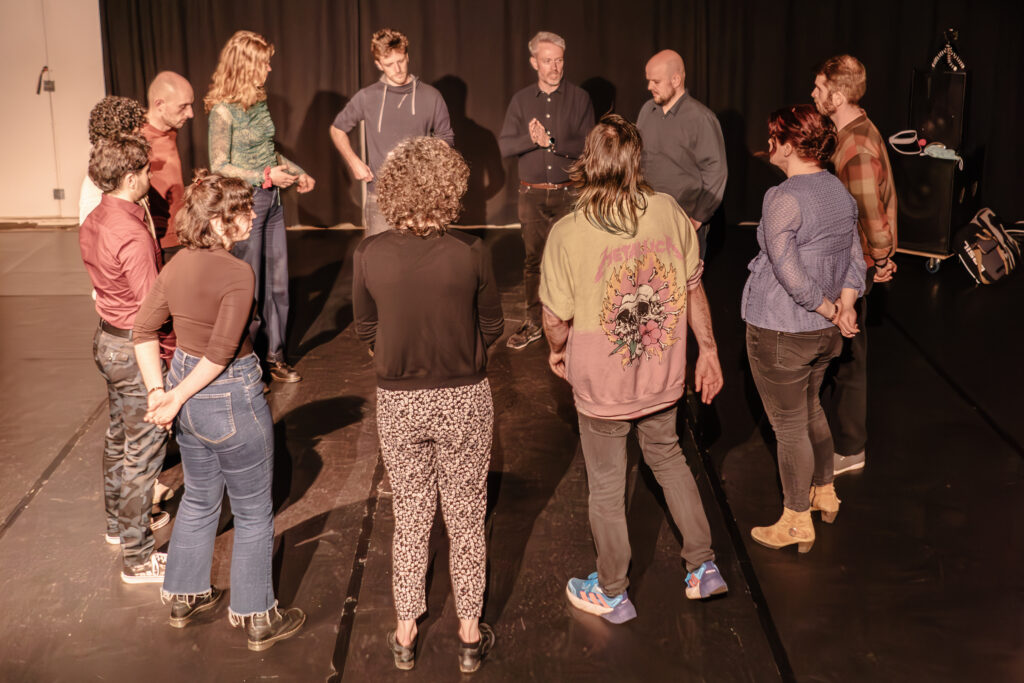
Long-form formats and show development
Steven has extensive experience teaching and coaching long-form formats, including The Harold, The Armando, SuperScene, and other narrative and theme-driven structures. Coaching in these formats goes beyond mechanics and beats, focusing instead on why the format exists and what it is trying to allow.
Work often centres on understanding Game, recognising the interesting thing in a scene, and having the courage to stay with it. Rather than rushing to new ideas or abandoning discoveries too early, players are encouraged to feel the fear of repetition and explore variations, heightening, callbacks, and emotional consequences.
Format coaching also looks at how group mind develops over the course of a show, how patterns emerge, and how players can support structure without forcing it.
Character as the engine of the scene
Strong character work is central to Steven’s approach. Characters are not treated as quirks or surface level choices, but as the primary driver of behaviour, response, and relationship.
Coaching explores how characters listen, react, interrupt, hesitate, and change. Particular attention is paid to the minutiae of human response, the tiny moments that make an interaction feel real. How quickly someone answers. Whether they avoid eye contact. How they react physically before they speak.
Techniques such as Jill Bernard’s VAPAPO are used as a starting point, but the work goes much deeper. Characters are developed with multiple facets, contradictions, and internal logic, closer to the depth seen in long running character work such as Comedy Bang Bang. This allows characters to surprise without becoming random, and to sustain interest over time.
Game, commitment, and letting things happen
Game is treated as something to be discovered and honoured rather than manufactured. Players are coached to recognise what is already interesting in a scene and to commit to it fully, rather than chasing novelty or clever tangents.
A key principle in this work is allowing absurdity to develop without being the person who deliberately pushes it. By committing truthfully to character, relationship, and behaviour, strange and delightful outcomes emerge naturally. The comedy comes from commitment, not from forcing jokes.
Players are encouraged to trust that staying grounded will often lead to more interesting results than trying to be interesting.
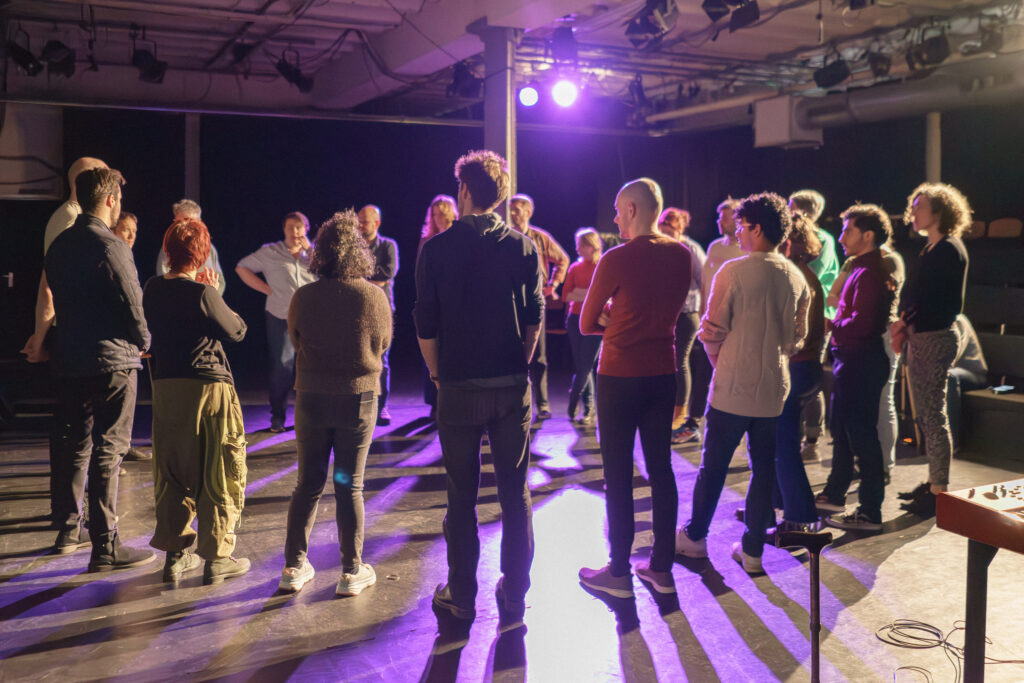
Physicality, space, and lived in environments
Physical work is given significant attention, particularly in how environments are created and inhabited. Scenes are coached to feel lived in rather than sketched, with care taken over spatial relationships, object work, and physical specificity.
Drawing on techniques from clowning, players are encouraged to slow down and notice what they are doing physically. The difference between miming an action and truly doing it is explored in detail. Picking up a spoon is not a single gesture, but a sequence of small adjustments, a brief search, a choice. These micro behaviours make a scene feel real.
Attention is also paid to how long actions take, how weight and resistance are suggested, and how physical choices support character and emotional state.
Listening, mirroring, and group awareness
Coaching places strong emphasis on listening, mirroring, and responsiveness. Players work on matching each other’s energy, pace, and emotional state, allowing scenes to breathe and evolve collaboratively.
Mirroring is treated not as imitation, but as attunement. The aim is to build shared reality through subtle alignment rather than overt agreement. This supports stronger relationships on stage and a clearer sense of ensemble.
Side coaching and directing are used thoughtfully, helping players notice habits and blind spots without overwhelming the work. Notes are framed to encourage curiosity and experimentation rather than correction for its own sake.
The role of music, lighting, and production choices
Steven’s coaching also considers the technical and aesthetic elements of performance. Music in particular is treated as a powerful storytelling tool, capable of transforming how a moment is perceived. Coaching includes working with musicians or playlists to support tone, rhythm, and emotional clarity.
Lighting, entrances, and stage picture are also discussed where relevant, recognising that these choices shape audience understanding and expectation. Even simple adjustments can significantly elevate the perceived quality of a show.
Adaptive coaching for each group
Every group is different, and coaching is always adapted accordingly. Some groups want to focus on structure and format. Others want to deepen character work, improve realism, or reconnect with joy and play. Some are preparing for a specific show, festival, or run. Others want long-term development.
Steven works collaboratively with groups to identify priorities, whether that is drilling specific skills such as status, emotional grounding, and relationship, or exploring broader questions about identity, taste, and direction.
The coaching creates a space where groups can take risks, challenge assumptions, and refine their work with intention.
A thoughtful, experience-led approach
At its heart, this improv coaching is about care. Care for the work, for the audience, and for the people on stage. It is about creating conditions where strong choices can emerge, where players feel supported to commit fully, and where the resulting performances feel alive, grounded, and worth watching.
For groups looking to deepen their improv practice with someone who understands both the craft and the experience of performance, Steven Morgan offers coaching that is rigorous, adaptable, and deeply invested in quality.